Never Fund Failure: Forte’s Bold Bet on Education & the Future of Work
September 8, 2025
By Gretchen Haga
—
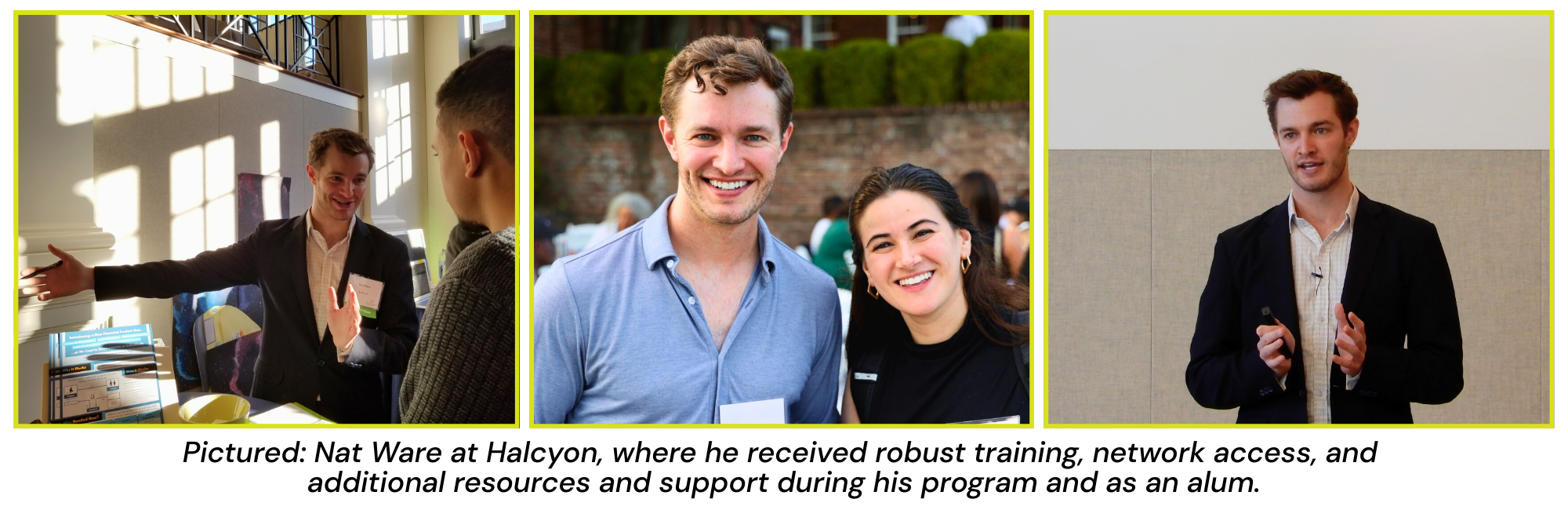
Raised by two schoolteachers, Nat Ware has spent his life working to make education accessible to all. At 16, he raised nearly $100,000 to rebuild a school in Mozambique. At 18, he launched 180 Degrees Consulting to help university students donate with their minds, building it into the world’s largest consultancy for non-profits with 185 branches across 42 countries. At 25, he began his PhD at Oxford, focusing on what he saw as the biggest unsolved challenge in global education.
“You’ve got hundreds upon hundreds of millions of people around the world who have inherent potential but are never given the opportunity to realize their potential,” he says.
Ware first analyzed every major approach to expanding access to high-quality education. He concluded that there were inherent structural flaws in each: philanthropy wasn’t scalable, scholarships were limited, loans created debt burdens, and government spending was often inefficient.
Then, he developed a 16-part framework outlining the essential elements of an effective education finance model. None of the existing approaches met even half of these criteria. So, he created his own: the Financing Of Return To Employment (FORTE) method.
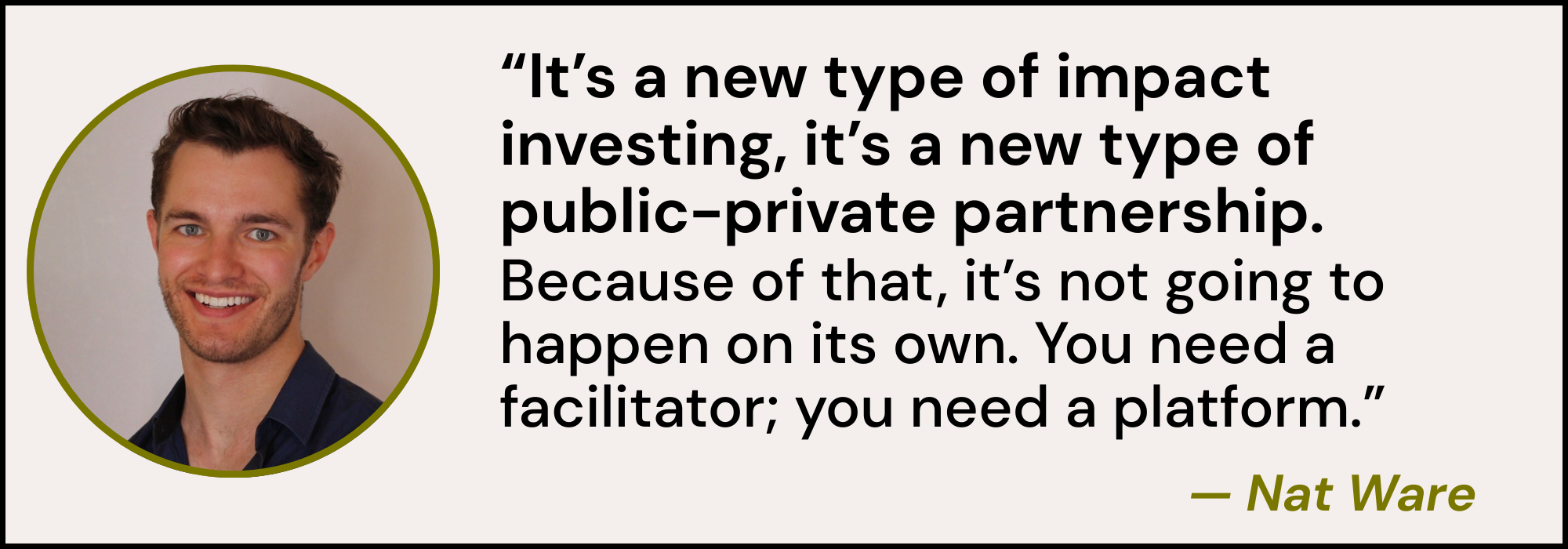
“FORTE is really a way to finance education and training at no cost to individuals, no cost to governments, and without needing philanthropy,” Ware explains. “It’s a way to have as much impact as scholarships, but with almost infinitely more scalability.”
When his PhD ended, Ware couldn’t let the idea go, and founded Forte, a venture built to implement this model globally.

Unlike other models, Forte pays for outcomes, such as employment or graduation, instead of paying for education upfront. This synchronizes incentives for all involved and ensures real protection for learners.
“There’s perfect alignment of social impact and financial return,” Ware says. “You can’t have a model where the way investors generate a return comes at the expense of the people you’re trying to help.”
Others are catching on to this trend. In July, the Social Finance Institute collaborated with regional Federal Reserve Banks in Atlanta, Chicago, Philadelphia, and Richmond to explore outcomes-based partnerships. Organizations like Google and AARP Foundation are now funding retraining programs for in-demand jobs tied to employment outcomes, and others are addressing sector-specific shortages in fields like nursing through similar innovative financing models.
Forte stands out by applying their unique, universal model at scale, uniting four key stakeholder groups to ensure a mutually beneficial solution:
-
Individuals
Forte participants—typically disadvantaged and facing unemployment—receive training without risk.
“There’s no debt, there’s no repayment, there’s no chance of exploitation,” Ware says. These individuals gain relevant skills, secure employment, increase their incomes, and support their families, all without paying a cent.
-
Investors
Forte offers investors a model where returns are tied directly to impact. When a participant’s income rises after training, the resulting rise in income tax revenue is shared with those who funded the training.
“The way investors make more money is by doing more good, by making sure the education actually works, and actually helps people, and actually leads to higher incomes and employment,” Ware says.
He calls it “trickle up economics,” a system where helping the disadvantaged directly leads to benefits that flow up through the entire economy.
-
Governments
Ware cites a World Bank estimate that 50% of global government education funding has no impact, resulting in hundreds of billions of dollars wasted. Forte presents an alternative: governments only pay when participants succeed.
Instead of upfront spending, governments return a portion of the increased tax revenue generated from Forte graduates’ higher earnings—revenue they wouldn’t have had otherwise.
-
Training Providers
Forte unlocks a new business model for education training providers. Rather than relying on grants or donations, they can receive funding at scale.
Forte has built vetted network of more 200 bootcamp-style, short-course global providers, including some universities. Each trainer goes through a rigorous screening process and often pilots a Forte program before joining.
This is also where Forte generates revenue: it takes a modest cut from provider payments—less than standard referral fees, Ware says—in exchange for access to their marketplace.
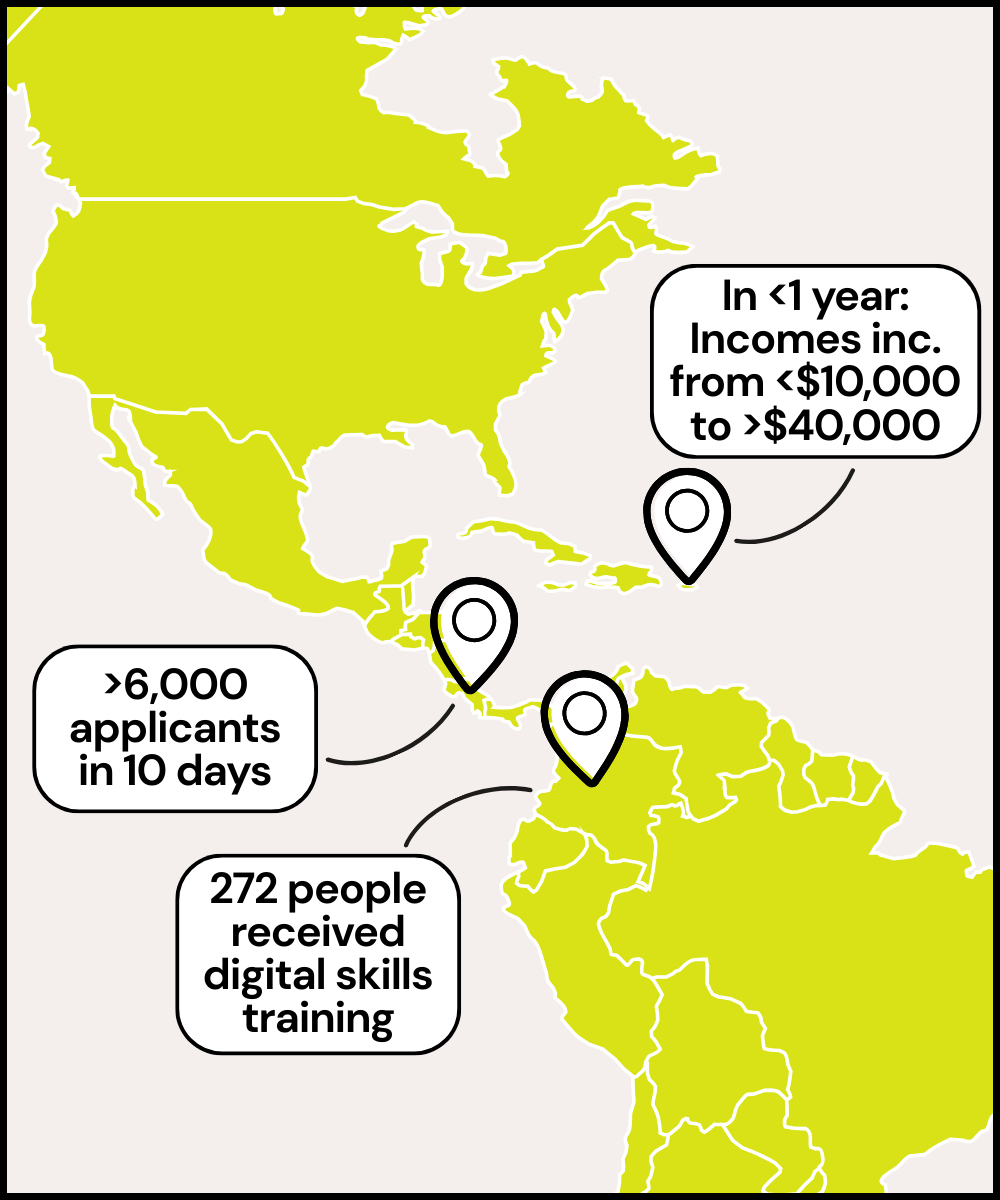
Latin America and the Caribbean (LAC) has been a region of particular success for Forte’s model:
-
Costa Rica
Forte’s program focused on developing pathways for women from rural areas drew more than 6,000 applicants in its first ten days. Graduates secured high-paying, quality employment in the country’s emerging tech industry.
-
Puerto Rico
Participants’ average incomes skyrocketed from under $10,000 to over $40,000 within a year. The cost of their training was under $2,000 each. Their new income tax contributions—approximately $7,000 to $8,000 per person—fully covered the investment.
-
Colombia
In the Medellín area, 272 people received digital skills training. Ware recalls one participant, a former food delivery cyclist injured on the job, who retrained and secured a better-paying role at an international IT company during his Forte program.
“He told me, finally, he feels like he’s a good dad. Finally, he feels like the universe of possibilities has opened up,” Ware recalled. “And when you hear those stories, it makes it real and meaningful.”
As Forte’s model gained traction, Ware noticed another gap: foundations, multinationals, and local governments were also eager to pivot towards an outcomes-based model, but didn’t know how.
“Because it’s so complicated, people throw up their hands, throw in the towel, and end up just saying, ‘Oh, I’ll pay 100% up front,’ Ware says.
The mechanics are daunting: identifying training providers open to outcome-based payments, writing effective contracts, verifying outcomes-based impact, and releasing funds at the right time, to name a few.
Forte’s software platform solves this by serving as a procurement and management hub for short-course education. It supports both Forte’s original tax pass-back model and other outcomes-based financing types.
Funders can choose the outcomes they care about and pay only when those results are achieved. Essentially, it’s a plug-and-play system for results-based impact.
“Think of the software platform as the way to never fund failure,” Ware says.
Looking ahead, Ware sees artificial intelligence (AI) as both a threat and an opportunity; it’s accelerating job displacement and increasing the need for retraining at a massive scale, he says.
“People who learn those skills, who can use AI effectively are going to be able to succeed and get ahead and achieve their potential,” Ware says.
Yet, most funders are aware of the importance of AI, but have little idea what to fund, who to trust, or how to track results, Ware argues.

That, he argues, makes Forte’s approach even more critical. If the Future of Work is uncertain, paying for results is the most responsible path forward.
“The combination of all those things—the fact that AI is increasing the need for retraining, and the fact that AI necessitates paying for outcomes to an increasing extent, I think is a big reason why Forte is needed now more than ever,” Ware says.
With its infrastructure and software in place, Forte is now scaling rapidly. A new project is underway in Peru, with more expansion planned throughout the region and beyond.
Forte’s ultimate vision is to be the digital infrastructure for human capital investment.
“Give me any issue in the world and there’s an application for this approach,” Ware says.
While education remains its focus, Forte could eventually support adjacent sectors like healthcare. Ware offers a hypothetical:
“If there are a million people with avoidable blindness, we could potentially use this model to fund eye surgery for a million people, and we only need about 3-5% of those people to [then go to] work for the model to pay for itself,” Ware said. “I don’t know any other model in the world where you can help a million blind people see, investors get their money back plus a small return, and their return in no way comes at the expense of the people we’ve helped. The point is: the model is very flexible.”
For now, Forte has a clear scaling goal: to bring quality education and training to at least 100 million people currently shut out of opportunity.
Halcyon is committed to supporting innovative founders and ventures through our EquityTech vertical focus, which empowers entrepreneurs across the United States and the globe leveraging technology to increase social and financial inclusion and close equity gaps in wealth, education, and accessibility.
Our 2025 EquityTech Fellowship will serve entrepreneurs in the EdTech and Future of Work sectors. To explore past Halcyon founders and ventures in this space, visit this link.