On the Ground at DC Startup & Tech Week
October 27, 2025
By Gretchen Haga
—
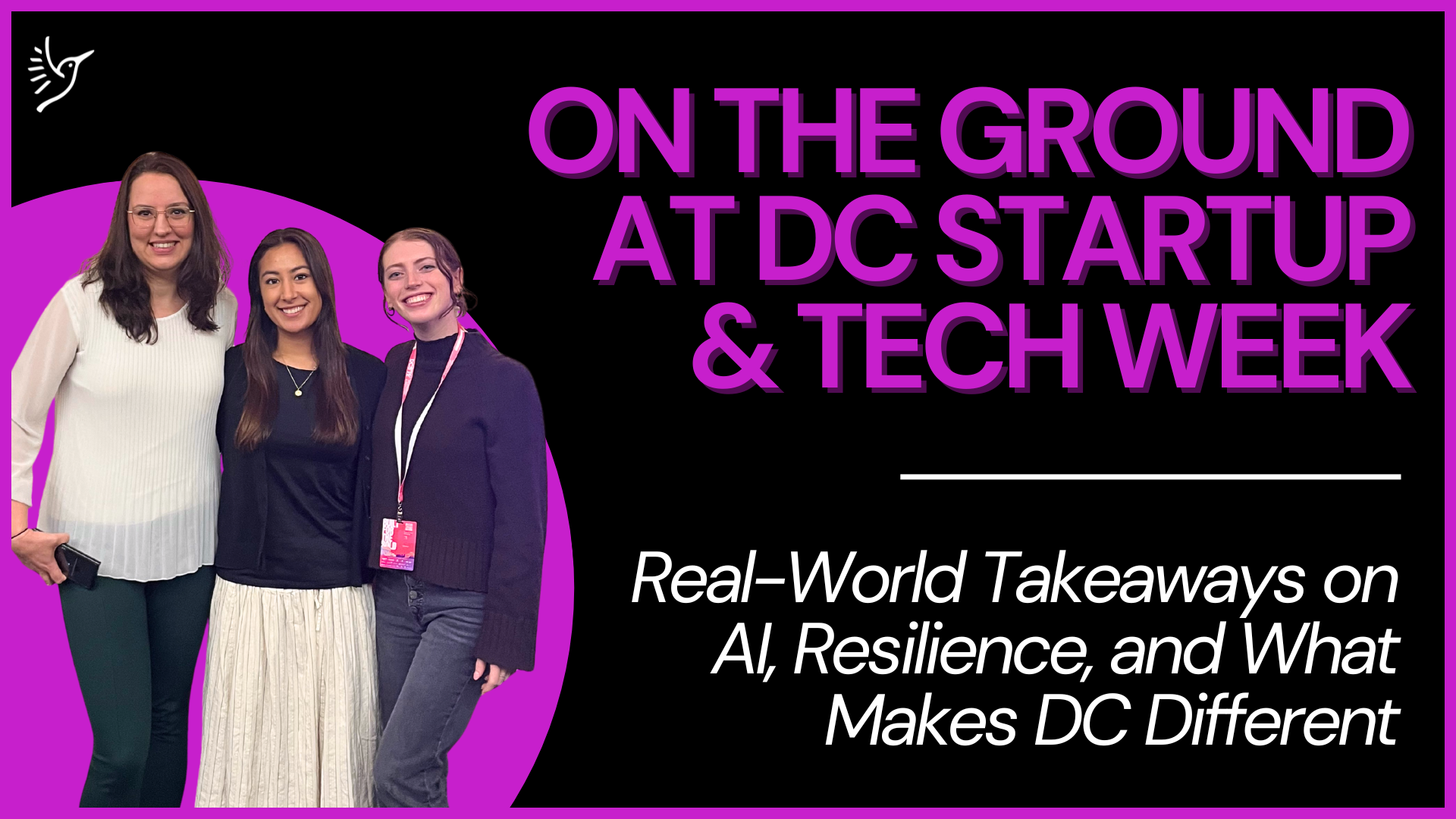
Last week, I was honored to attend DC Startup and Tech Week (DCSTW) for its 10th anniversary. I was particularly excited to join sessions on the Startups for Good (S4G) track thoughtfully planned and co-led by my Halcyon colleagues, Erna Redzepagic and Alexis Kartalian. Throughout the S4G track and beyond, key lessons emerged on building with resiliency in today’s evolving landscape, trends in AI, DC’s role in entrepreneurial innovation, a renewed focus on customers, and more.

AI
Unsurprisingly, the topic of AI dominated the week’s discussions. The dialogue has firmly shifted from whether to adopt AI to how ventures can incorporate it strategically, meaningfully, and ethically. From an investor’s view, Halcyon Venture Partners’ (HVP) Kate Goodall summed the message clearly: “Not everyone is building an AI company, but everyone should be building an AI-enabled company.”
One of the most compelling conversations came from Halcyon alum Kenneth Watson, who highlighted the staggering inequities present in the data underpinning much of precision medicine (where over 90% stems from a Eurocentric male demographic). Simply layering AI on these datasets without interrogation wouldn’t advance innovation, it would automate biases and codify those inequities into our new technologies.
Kenneth’s venture employs AI models to prioritize underserved populations, while also conducting on-the-ground community engagement to ask questions, build trust, and include those historically excluded from medicine. Through this work, Kenneth believes AI can be a force for greater human good, prompting a deeper look into our industries and outdated systems. As AI is being deployed at scale, we can leverage data at-large to challenge the status quo and disrupt the ‘haves’ and ‘have-nots’ divide.
Kenneth also emphasized the need to remember the humans behind the screen, sharing a powerful reminder: use AI as a tool for data-informed decisions, not data-led decisions. AI shouldn’t dictate outcomes or replace human judgment; rather, it can support us in making better, more exact decisions by providing depth, context, and nuance.
This prompts the broader, culturally prominent conversation on AI safety and regulation. As always, it was incredibly reassuring hearing from Halcyon alum, Juan Manuel Contreras, on the work his venture, Aymara, is doing to ensure enterprises are measuring the safety and accuracy of their AI systems. Juan Manuel used the perfect metaphor: AI is a car, and safety is its brakes. Speed and innovation matter, but deploying AI rapidly without built-in safety systems invites a crash. In a field moving at high velocity, these guardrails aren’t optional.
Finally, thinking with the lens of human-centered design brought everything together. Across the board, panelists agreed that the technology is powerful, but only when it’s been translated into something accessible, useful, and trusted by their end users.
Ignitia’s Andrew Lala offered an excellent example from his work in Brazil. Andrew focused on the behavioral habits of farmers, observing that they check WhatsApp each morning for weather updates. So, Andrew and his team created a simple PDF that filtered their venture’s advanced, AI-generated climate and weather intelligence and delivered it through to farmers’ preferred messaging channels. This went against their inclination to build a complex mobile app for their meteorological data, but it worked. Andrew successfully bet on the idea that even the most sophisticated AI means very little if it misses a user’s daily realities.
Customers at the Core
In today’s unpredictable landscape—of shifting regulations and policies, rapidly emerging technologies, and uncertainties in the Capital and beyond—entrepreneurs are returning to their core: the end customer.
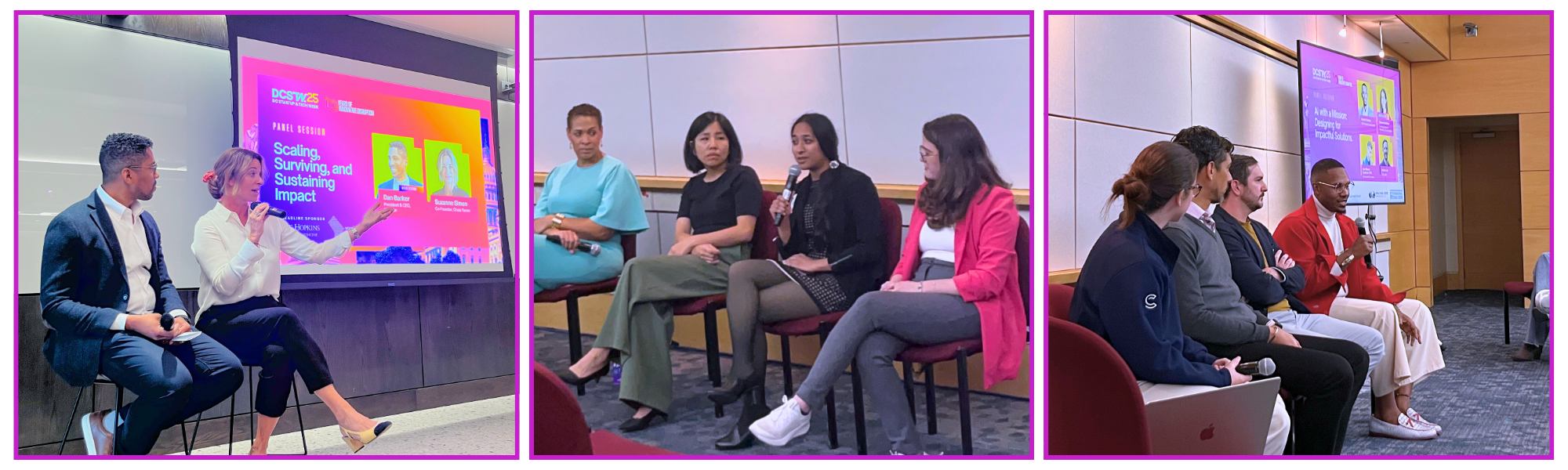
Just Ice Tea’s Seth Goldman framed this as “bringing the power back to the consumer,” sharing how his company launched in direct response to public demand rather than corporate convention. Similarly, Chaia Tacos’ Suzanne Simon spoke in her keynote Q&A with Halcyon’s Dan Barker on the potential of behavioral innovation, building her impact-driven business in a way that adapted to the needs and behaviors of her customers to drive change.
In a world overflowing with data and rapid technological advancement, the strongest ventures are those that are translating complexity in a way that informs users clearly, concisely, and to their greatest benefit. That thread ran through Kenneth’s goal of empowering patients to “know more about their body than they know about their cars,” imagining a future where individuals walk into a doctor’s office equipped with a deep understanding of their personal health data and ready for a dialogue, not a vague diagnosis. Similarly, Andrew described his mission on the climate resilience front as “equipping individuals with their own information,” to make them active participants in weather risk prevention, safety, and recovery.
On a panel on ‘The Power of Proximity: Where Do the Best Solutions Come From?,’ Halcyon alum Akshaya Anand and current EquityTech founder Jane Kim echoed the importance of customer discovery as a constant process. It’s so essential, Akshaya noted, that institutions like the National Science Foundation (NSF) fund it through their (NSF) I-Corps Teams $50K customer discovery grants. Jane and Akshaya’s fellow panelists emphasized that knowing what your customers will actually pay for is the ultimate test.
The Power of Resiliency
Set against DC’s shifting political and regulatory backdrop, many S4G track conversations circled back to one essential trait: resiliency. Founders and funders spoke candidly on leading through volatility when markets, investor priorities, and even global supply chains can change overnight.
Kate shared how one portfolio company had to relocate a manufacturing facility in response to new tariffs, while Suzanne recounted a moment when an expansion deal was sidelined. Instead of setbacks, these moments became inflection points that tested founders’ clarity of purpose and adaptability. Suzanne’s story also offered valuable lessons in investor relations: honesty builds trust. Have the courage to keep your communication constant—especially during challenging times—and keep people around you who energize you.
HVP’s Dahna Goldstein and Halcyon’s Marcelo Homrich also echoed this advice through a leadership lens. Business models, financial projections, and other parts of your venture will change, so stay guided by your north star. In moments of turbulence, knowing your values and strengths will be the foundation for your growth and success.
DC

Throughout the week, one idea resonated above all: there’s something special about building in DC. I’ll admit, I didn’t realize just how distinctive this business ecosystem is, or just how much it’s poised for growth.
In his keynote, Ted Leonsis captured DC’s unique blend of history, influence, and innovation. Our region’s entrepreneurial story stretches further back than most realize, and the history of the Internet and early emerging technologies can be traced right back here! Ted told the story of Waxpool Road, charting the Northern Virginia hotspot that once hosted 80% of the world’s web traffic, and still houses major data centers and HQs.
Ted also traced how dominant global trends, from sports betting to the role of women in the tech ecosystem, all found early traction here thanks to DC’s policy ties. That same dynamic is now shaping how DC approaches AI, positioning us to lead the charge on its regulation and responsible evolution.
This fusion of innovation, governance, and purpose is what makes DC an ideal home for impact-driven entrepreneurs. It attracts founders, funders, and other ecosystem players who care about systems-change, and are working together to make it happen.
Amid the energy and optimism, founders and investors also reflected on ongoing challenges in the impact investing landscape. Some described the current climate as “brutal,” and other barriers remain, with other entrepreneurs speaking honestly about their struggle to bridge the gap between proof of concept and investor readiness. One solution? Patrice Brickman, Founder & CEO of Inspire Access and Halcyon Board of Directors alum, framed this as a critical moment to reimagine not only how capital flows, but what kinds of capital we value, and perhaps to also rewrite our narrative around impact investing itself.
This set the tone for what became the S4G track’s defining insight: technology doesn’t lead transformation, people do. Innovation only matters when it’s applied with purpose, solving real problems for real people. Founders at DCSTW are now tackling how to get these solutions in the hands of those who need them most.
As Andrew noted, we have the technology, it’s about diffusion, overcoming policy and market challenges, and more that become the next chapters for entrepreneurs and the ecosystems around them. Progress isn’t defined by the speed of innovation, but by the intention behind it.
The future envisioned at DCSTW is one I’m eager to be a part of, and I’m proud to be a member of the team at Halcyon supporting impact-driven ventures here in DC, across the US, and worldwide.