By Andréa Wooten
—
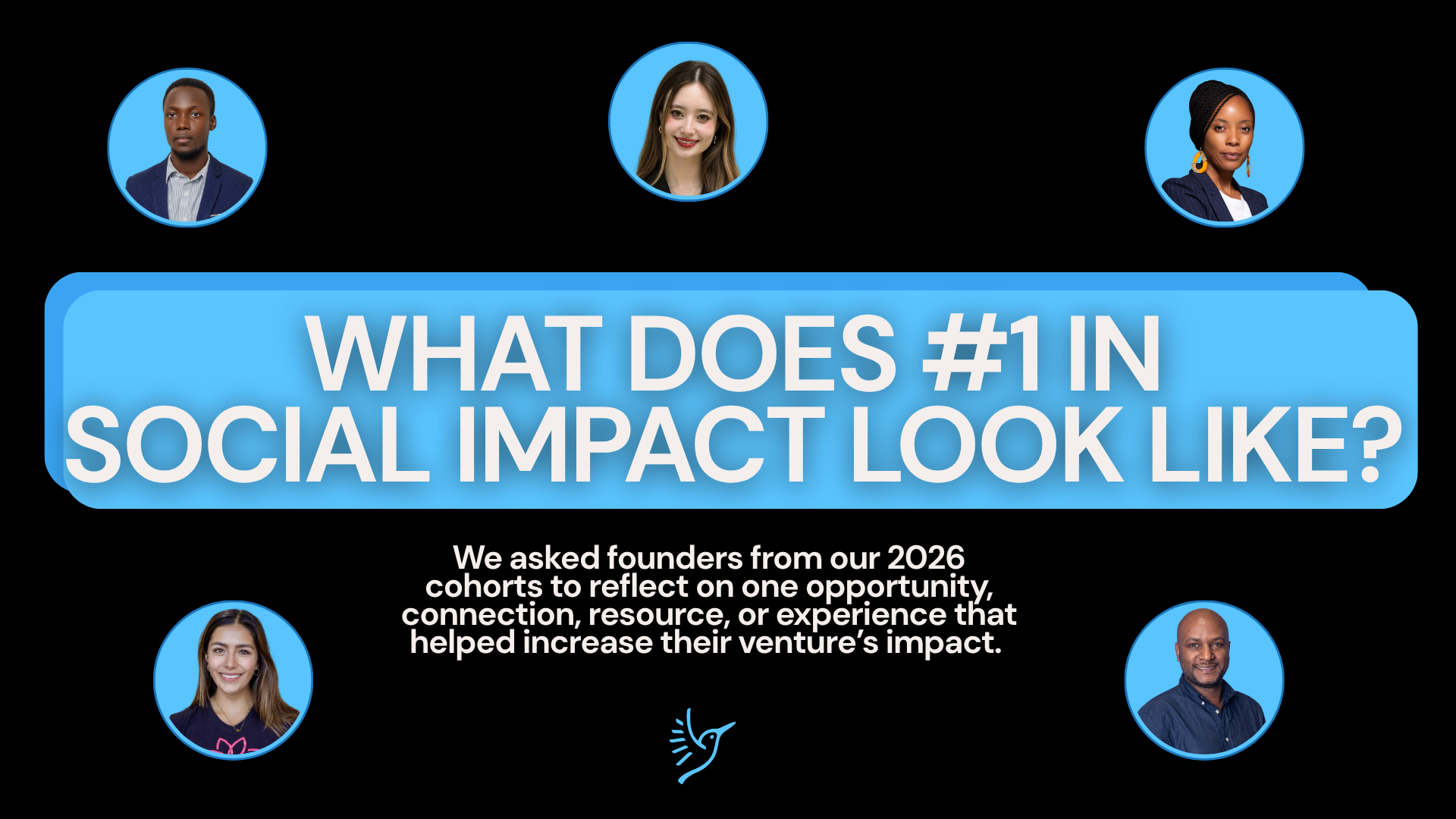
#1 in Social Impact is a big claim, and this August TIME’s America’s Best Incubators and Accelerators list gave us the chance to make it. We’re proud of the recognition, but a ranking can’t show you what that looks like day to day. Our founders can.
So, we asked. We reached out to a few founders from our 2026 cohorts with one question: what’s one opportunity, connection, resource, or experience you gained through Halcyon that helped you increase your impact?
The ventures behind the answers are very different: a farmer advisory service in Colombia, irrigation in Ugandan refugee settlements, climate finance infrastructure, food compliance technology in Zambia, and climate risk software for real estate. But each one is closing a gap between people doing the work and what they need to move forward. That might mean connecting farmers with agronomists, bringing reliable water to underserved communities, helping climate projects access capital, opening new markets for smallholder farmers, or giving asset owners better visibility into climate risk.

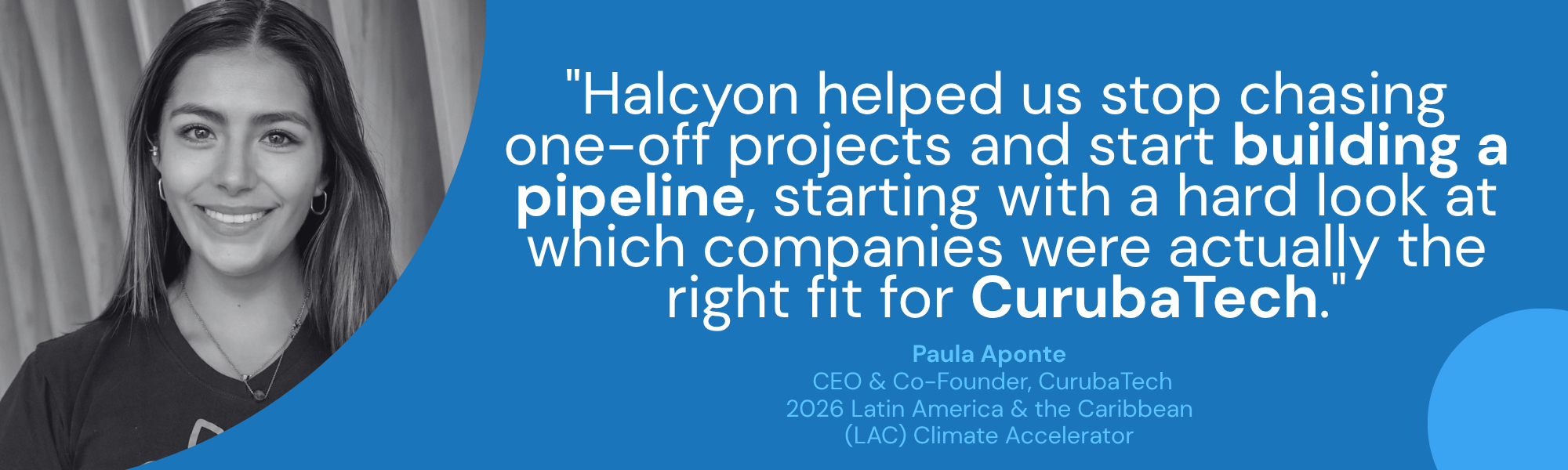
Paula Aponte, CurubaTech
2026 Latin America & the Caribbean (LAC) Climate Accelerator
Colombia has the land, crops, and agricultural expertise to be a major food producer. But for many smallholder farmers, getting the right expertise at the right time is still difficult. Distance and limited rural infrastructure can make it hard for agronomists and other specialists to reach farming communities, leaving producers to make critical decisions with limited information. The consequences can show up in lower yields, wasted inputs, unstable incomes, and missed opportunities to reach better markets.
CurubaTech was built around that gap. The B2B agriculture platform connects smallholder farmers with expert agronomists remotely through technology they already use, including WhatsApp and SMS. Farmers can share information about their crops and receive personalized guidance throughout the growing cycle, while the resulting data helps agrifood companies improve productivity, traceability, and transparency in their supply chains. CurubaTech reports more than 40% growth in production through its tailored farming programs.
For Paula, the next challenge was figuring out where that model could have the greatest impact and which opportunities were worth pursuing:
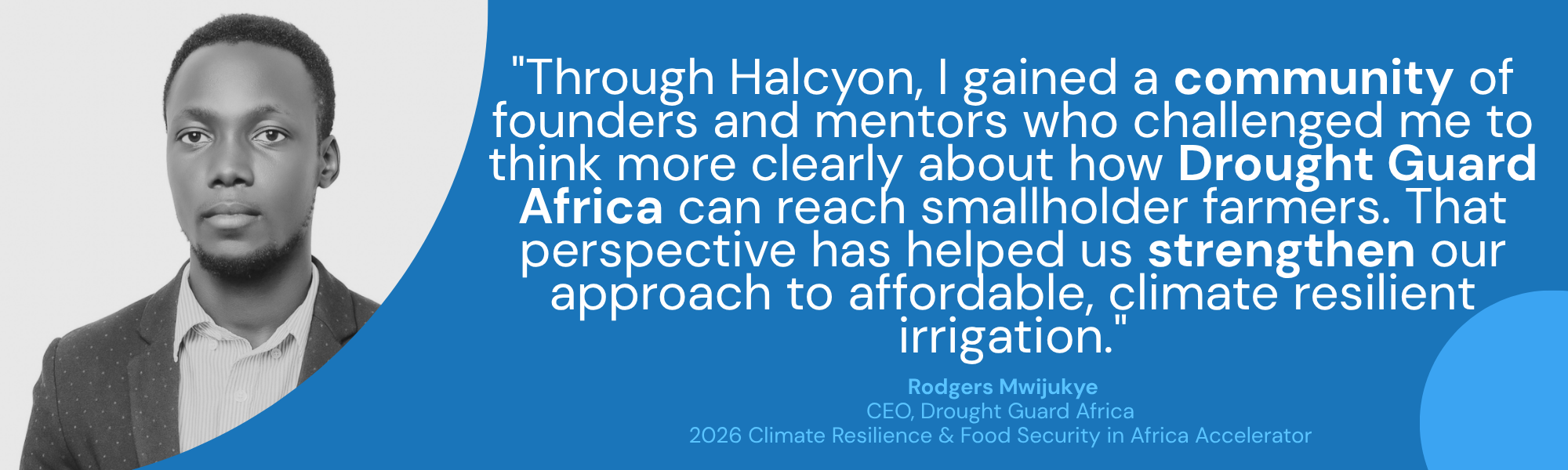
Rodgers Mwijukye, Drought Guard Africa
2026 Climate Resilience & Food Security in Africa Accelerator
Mwijukye and his co-founder, Ronald Asiimwe, met in high school in Uganda in 2015. Raised in a drought-prone farming community, Mwijukye saw firsthand how water scarcity and unreliable energy could deepen poverty and food insecurity. He went on to study water and irrigation engineering, and in 2023, the two founded Drought Guard Africa.
Drought Guard designs and installs affordable, locally adaptable irrigation, clean water, and solar systems for rural farmers, refugee settlements, and underserved communities. For Uganda’s smallholder farmers, many of whom still depend on unpredictable rainfall, the cost and complexity of irrigation can put climate resilience out of reach. Drought Guard is working to change that by making reliable water and energy systems more accessible.
For Mwijukye, figuring out how to reach more farmers was a question that benefited from outside perspective:
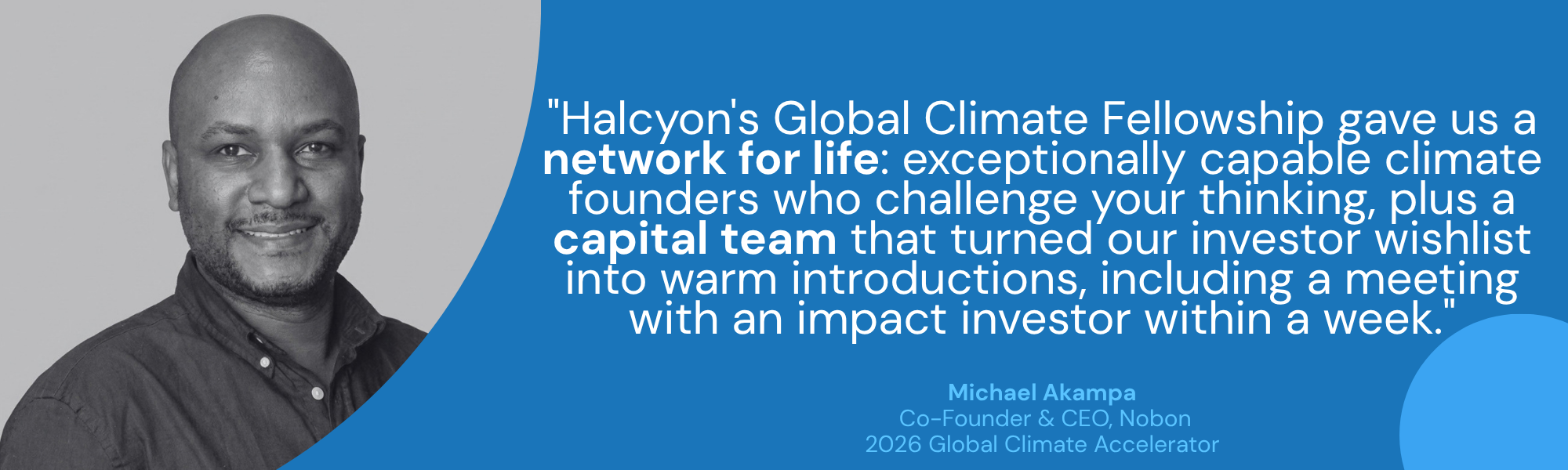
Michael Akampa, Nobon
2026 Global Climate Accelerator
Michael grew up in Uganda and spent years working with project developers across Africa in climate, agriculture, renewable energy, and nature-based solutions. Many of them were shut out of global finance because the system wasn’t built with them in mind. Nobon, founded in Stockholm in 2020, gives carbon and climate project developers one platform to move from feasibility to financing to credit sales. The company reports supporting 50+ projects and facilitating more than $40 million in capital.
For Michael, the experience was defined by both community and access:
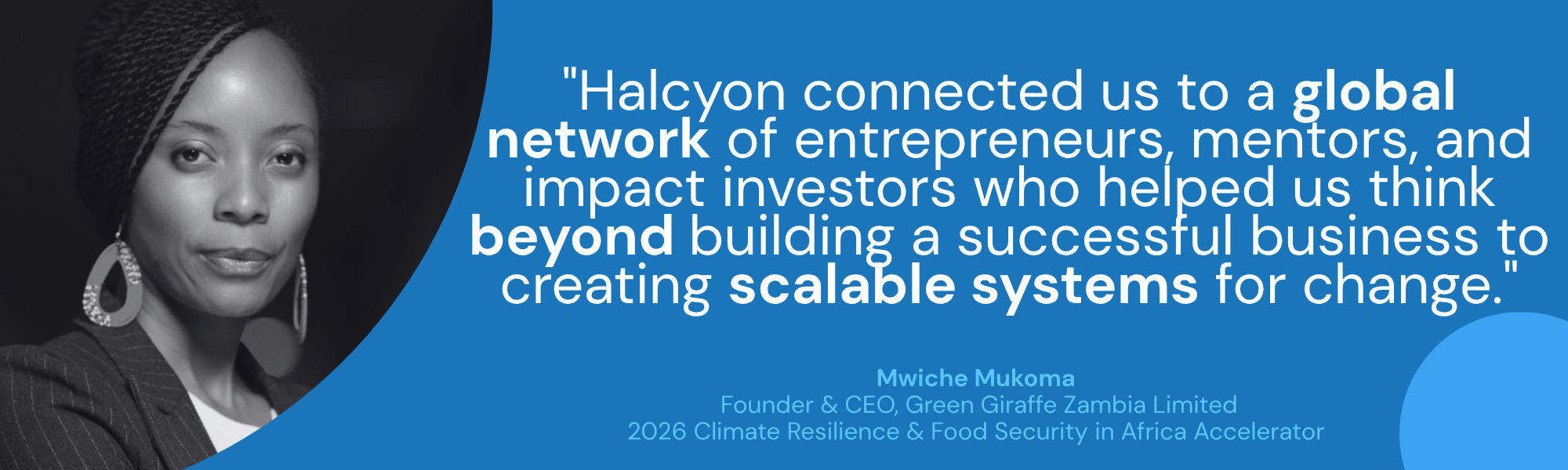
Mwiche Mukoma, Green Giraffe Zambia Limited
2026 Climate Resilience & Food Security in Africa Accelerator
Mwiche and her co-founder, Joseph Simukoko, started Green Giraffe as a food business, sourcing ingredients from smallholder farmers in Zambia and building traceability into the snacks they sold. But as they worked with farmers and followed products through the supply chain, they encountered a problem that went beyond the snack business: they couldn’t easily capture, verify, and organize the information needed to prove where food came from or how it was produced. Their first traceability system grew from that experience.
That problem matters in a country where agriculture is a major source of livelihoods, particularly in rural communities, yet many smallholder farmers face low productivity, limited market access, and climate vulnerability. Green Giraffe’s technology has evolved into Jiraffe AI, an AI-powered platform that turns farmer interactions into structured, audit-ready records, helping food brands and exporters document supply chains, meet increasingly demanding compliance requirements, and connect African producers to regulated international markets.
For Mwiche, Halcyon expanded the conversation:
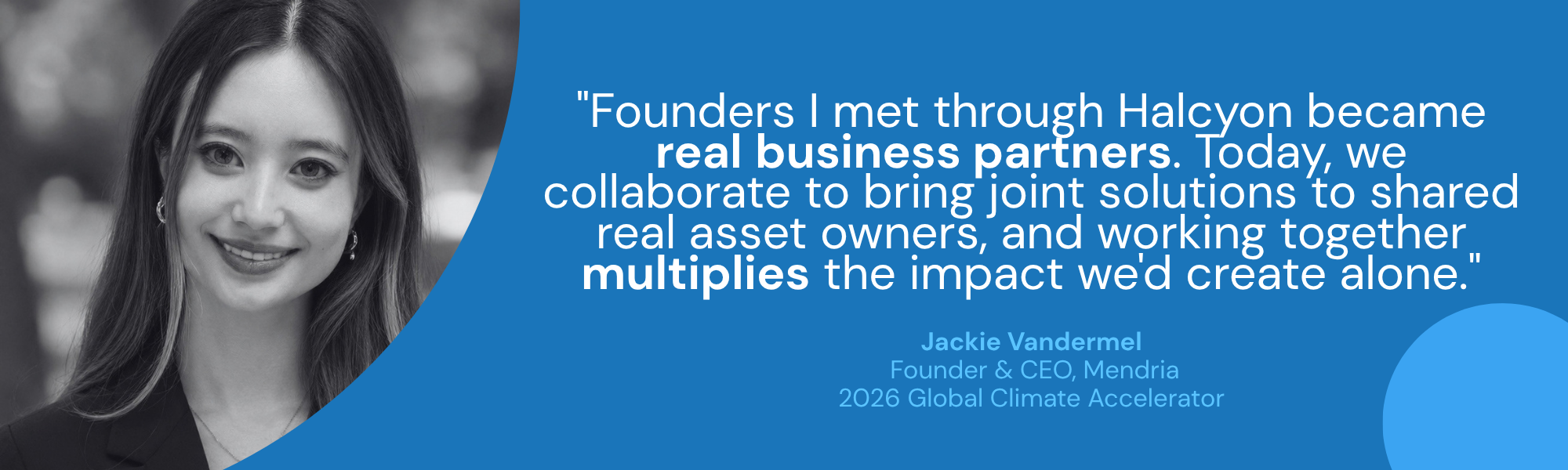
Jackie Vandermel, Mendria
2026 Global Climate Accelerator
Buildings and construction account for roughly 37% of global CO₂ emissions, making real estate both a major source of emissions and increasingly exposed to the financial consequences of climate change. Physical risks like extreme heat, flooding, and wildfires can affect assets directly, while the transition to a lower-carbon economy can change how properties are financed, insured, and valued.
Mendria is an AI underwriting platform for REITs, real estate private equity firms, family offices, and governments. It models how lenders, insurers, and buyers may reassess an asset, predicting when properties could become harder to refinance, insure, or sell and quantifying equity at risk before it appears in financial statements. The platform then delivers 12–36 month action plans to help owners preserve value.
For Jackie, one of the most meaningful outcomes happened founder-to-founder:
So, What Does #1 in Social Impact Look Like?
A founder finding the right customer. Another being challenged to rethink how they reach farmers. An introduction becoming an investor conversation. A company growing beyond the business it started as. Two founders meeting and realizing they can build something together that neither could build alone.
Each moment is small on its own. Together, they show what can happen when founders have access to the people, knowledge, capital, and opportunities that help turn promising solutions into lasting impact.
That is what we have been building at Halcyon since 2014. More than 650 founders have come through our programs, and the ventures we’ve supported have collectively raised more than $870 million.
Thank you to TIME and Statista for the recognition, and to every Halcyon founder who keeps building, collaborating, and showing up for one another.